Why Two Hotels on the Same Street Get Completely Different Results Online
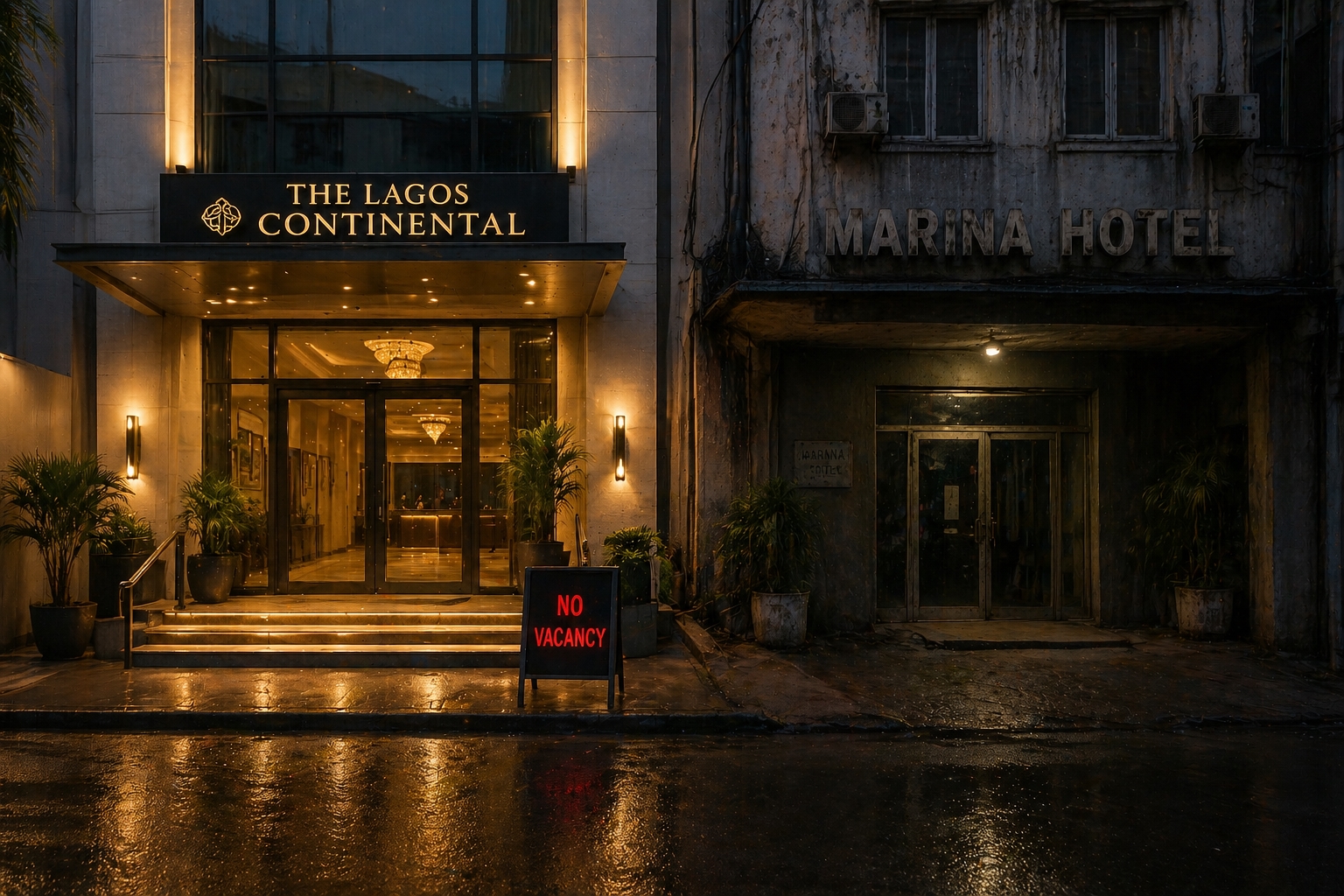
Location, price, and room quality matter less than most hotel owners think. Here’s why one property fills consistently while an almost identical neighbour struggles — and what separates them.
Key takeaways
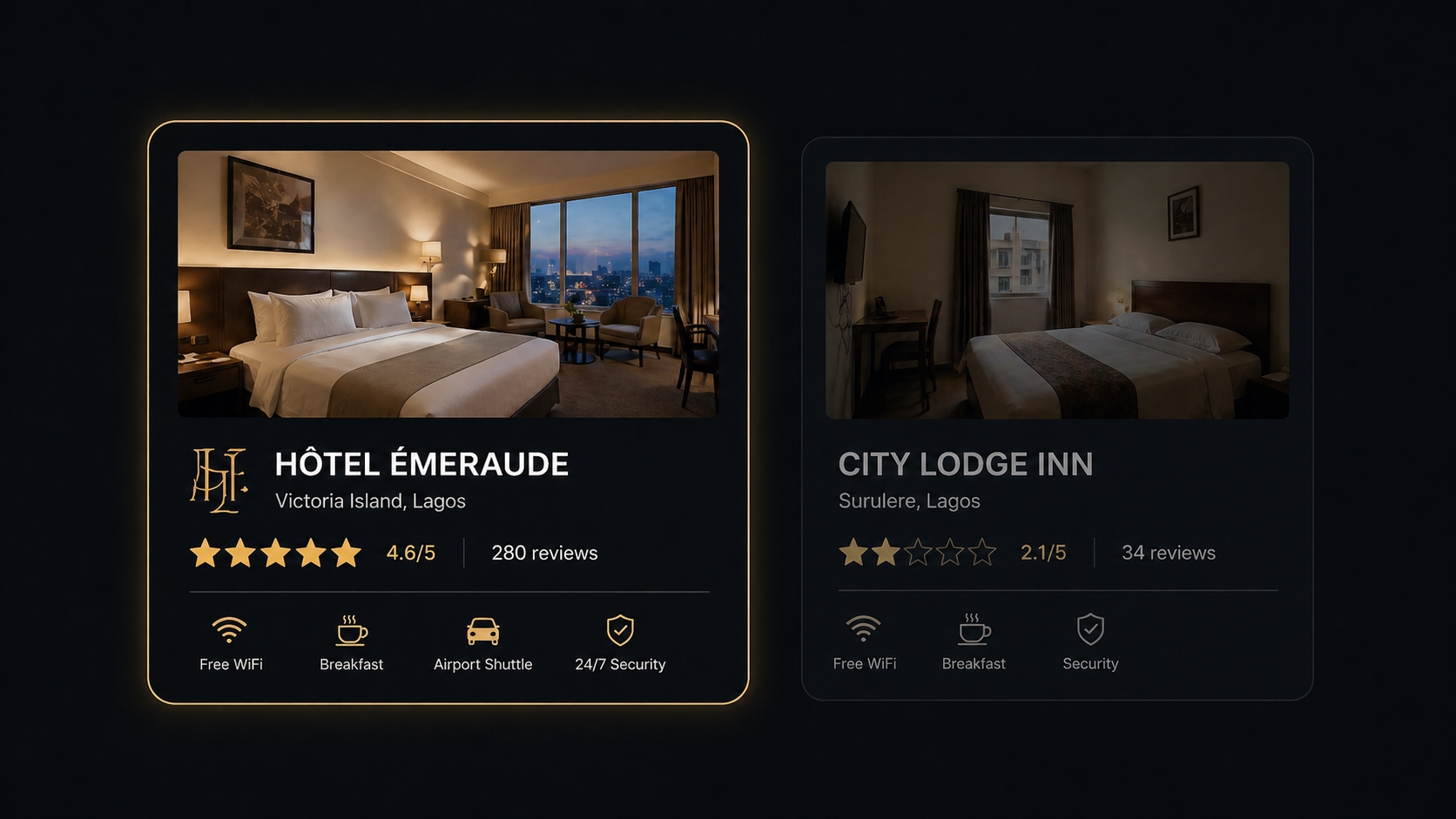
- Review volume compounds — a hotel with 280 reviews usually outperforms one with 34, even if the latter has a higher score.
- A longer booking window protects your rate; last‑minute price cuts train OTAs to see you as a discount option.
- A functioning direct booking channel (not just a website) can shift 20‑25% of reservations to commission‑free bookings.
- Fast response to messages matters — guests book elsewhere while you’re still drafting your reply.
- Price, location, and room product are rarely the real cause of underperformance — digital presence and habits are.
There is a pattern visible across almost every city in West Africa with a meaningful hospitality market. Two hotels, within walking distance of each other, serving a similar guest profile at comparable prices. One fills consistently, generates a steady flow of reviews, and appears near the top of OTA search results. The other operates at 40% occupancy in high season and struggles to explain why.
The owners of the underperforming property usually attribute the difference to factors outside their control: the other hotel has been open longer, it has better connections, it got lucky with a few large groups that turned into repeat clients. Sometimes these factors are real. Mostly, they are not the primary cause.
What separates consistently performing hotels from their identical‑seeming neighbours is almost always visible, specific, and fixable. Here is what it actually looks like.
The compounding effect of review volume
Imagine two hotels. Hotel A has been on Booking.com for four years and has accumulated 280 reviews with an average score of 8.1. Hotel B opened two years ago, has 34 reviews, and an average score of 8.4.
Hotel B is objectively better‑reviewed. But Hotel A fills faster, because at the moment of booking decision, 280 reviews means something that 34 cannot replicate. The volume signals that hundreds of guests have trusted this property and the majority have been satisfied. The higher score at Hotel B is not enough to overcome the uncertainty that low volume creates for a first‑time guest.
Review volume compounds. Properties that have been actively encouraging reviews for two or three years have an advantage that a competitor with a better room product cannot overcome in the short term without the same deliberate effort. This is not luck. It is the result of a habit — asking guests to leave feedback consistently, at every checkout, across every platform — that many hotels have simply never started.
The booking window difference
Hotels that fill consistently typically have a longer average booking window than those that struggle. This is both a cause and an effect.
When a property appears early in OTA search results — because of its review volume, profile completeness, and pricing strategy — it captures bookings made months in advance. Those confirmed bookings reduce the pressure to lower prices as the arrival date approaches, which protects margin and signals to the OTA algorithm that the property is in demand. That demand signal improves ranking further, which generates more early bookings.
The property operating at low occupancy, by contrast, is not capturing those early bookings. It reduces its rates as the date approaches to stimulate last‑minute demand, which trains the algorithm to see it as a discount option, which attracts more price‑sensitive guests, which generates lower review scores, which suppresses ranking.
The same market conditions. Opposite trajectories.
The direct booking gap
The consistently performing hotel almost always has a functioning direct booking channel. Not just a website — a website with an integrated booking engine, a reason to book direct (a best rate guarantee, a complimentary breakfast, a confirmed room preference), and staff who mention it to guests at checkout.
That direct booking share — even if it is only 20 or 25% of total reservations — changes the economics of the operation fundamentally. The margin on a direct booking versus an OTA booking, at a 15% commission rate, on a 50,000 CFA room, is 7,500 CFA per night. Across 200 room nights per year that shift from OTA to direct, that is 1.5 million CFA that stays in the business rather than going to Booking.com.
The struggling hotel down the road has the same website. It may even have the same booking engine. But it has never actively promoted the direct channel, has no offer that makes it more attractive than the OTA, and treats the website as a digital brochure rather than a revenue channel.
The response time gap
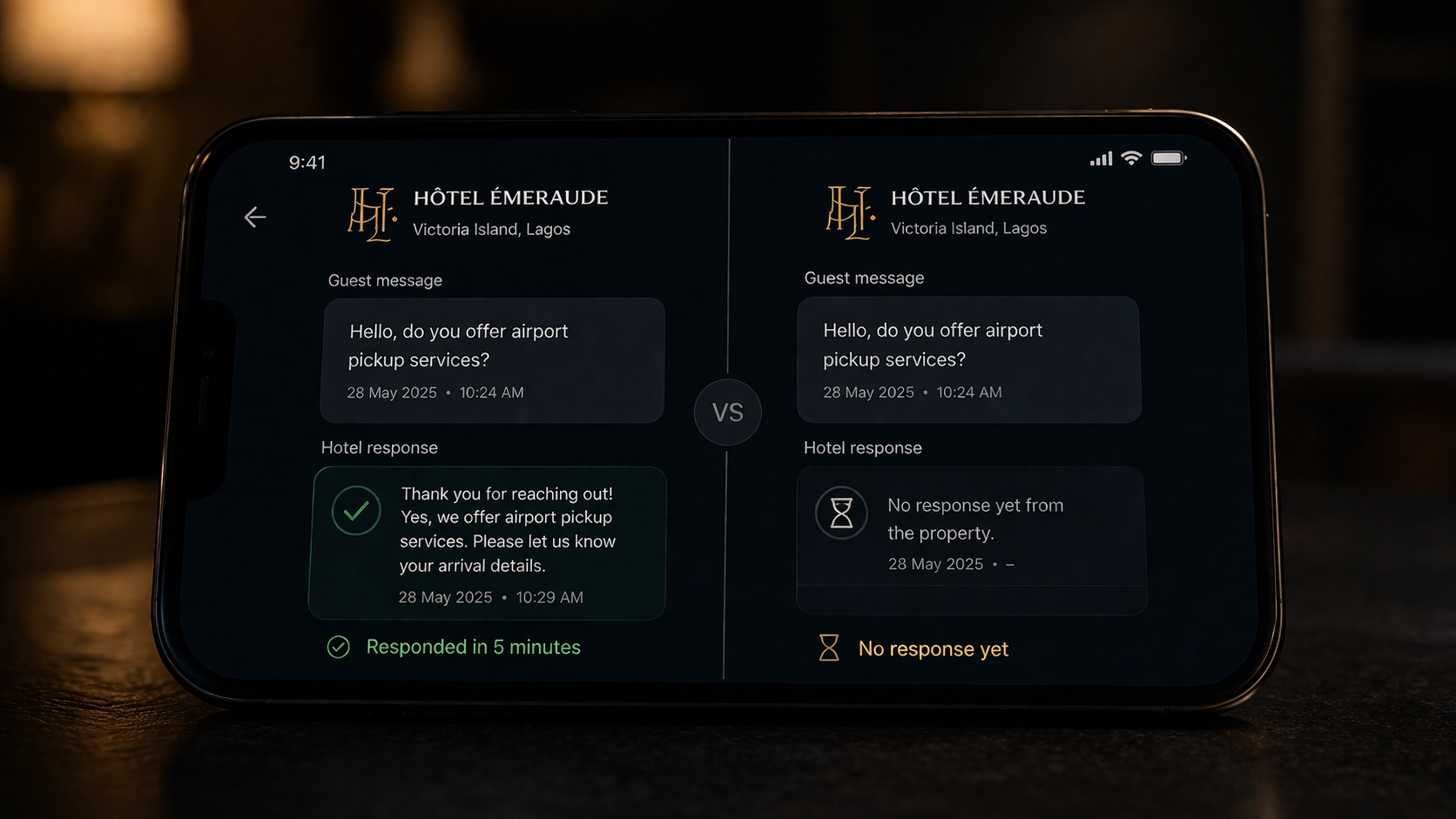
The performing hotel responds to guest messages within an hour during business hours. Not because it has more staff — often it has fewer — but because it has made response time a managed metric rather than a best‑effort activity. Someone specific is responsible for OTA inbox management. The Booking.com Pulse app is installed and checked. WhatsApp messages to the hotel contact number are answered before the shift ends.
The struggling hotel responds when someone gets to it. Messages received in the evening are answered the following morning. Enquiries that arrive on Sunday are addressed on Monday. In the time between message and response, a guest who was ready to book has confirmed elsewhere.
What the gap is not
It is rarely price. Hotels that consistently underperform on occupancy often believe they are priced correctly because they are in line with their immediate competitors. But pricing strategy is not just the rate — it is how the rate relates to perceived value, how it changes across the booking window, and how it compares across channels. A hotel priced identically to a better‑reviewed, faster‑responding, more visible competitor will lose that comparison every time.
It is rarely location, for properties within a few hundred metres of each other. Guests searching on OTAs and Google Maps apply filters — price range, amenities, review score — that surface relevant properties regardless of the precise address. A hotel three streets away from the beach with 300 reviews ranks above one on the beachfront with 20.
It is rarely the physical product, at the moderate to mid‑range tier where most independent hotels operate. Guests at this tier have calibrated expectations that a clean room, reliable WiFi, and consistent service will meet — the extraordinary room makes less difference than the extraordinary review consistency.
Where to start
If you recognise your property in the hotel that is underperforming despite being comparable to a fuller neighbour, the most useful first step is a direct comparison exercise.
Look at your nearest consistently full competitor’s Booking.com listing. Count their reviews. Read their most recent 20. Look at their profile completeness, their photo quality and volume, their policy setup, and how they respond to reviews. Then look at your own listing with the same eyes.
The gap between what you see in theirs and what you see in yours is almost always the gap in your results.
Ginform offers a free digital audit for hotel properties across West Africa — a direct analysis of where your online presence is falling short of properties comparable to yours, with specific, prioritised recommendations.