What Your Hotel’s Reviews Are Actually Telling You — And How to Use Them
Guest reviews are business intelligence, not just a score to manage. Most hotels read them defensively. The ones using them as data are making better decisions about operations, pricing, and positioning.
Key takeaways
- Frequency patterns in reviews reveal operational issues (like slow service or WiFi) that need fixing, not just individual complaints.
- Language around “value” is a leading indicator — if guests consistently say you’re overpriced, it’s already costing you bookings.
- Track competitor mentions in reviews to see who guests are really comparing you with.
- Your best reviews tell you exactly which guest profile to target — market to that audience deliberately.
- Reviews that feel unfair often spotlight a gap between your marketing and the actual guest experience.
Most hotels approach guest reviews as a reputation management problem. A negative review appears and the response is defensive — either ignore it, dispute it, or post a polite reply and move on. Positive reviews get a thank‑you. The score is monitored because it affects OTA ranking. That is usually where the analysis stops.
This is a waste of one of the most valuable sources of business intelligence available to an independent hotel.
Your reviews, read systematically rather than reactively, contain a detailed picture of what your hotel is doing well, where it is consistently failing, how guests perceive your pricing relative to your delivery, and what your competitors are getting right that you are not. None of this requires a data analyst or specialist software. It requires reading your reviews with a different kind of attention.
What review patterns actually reveal
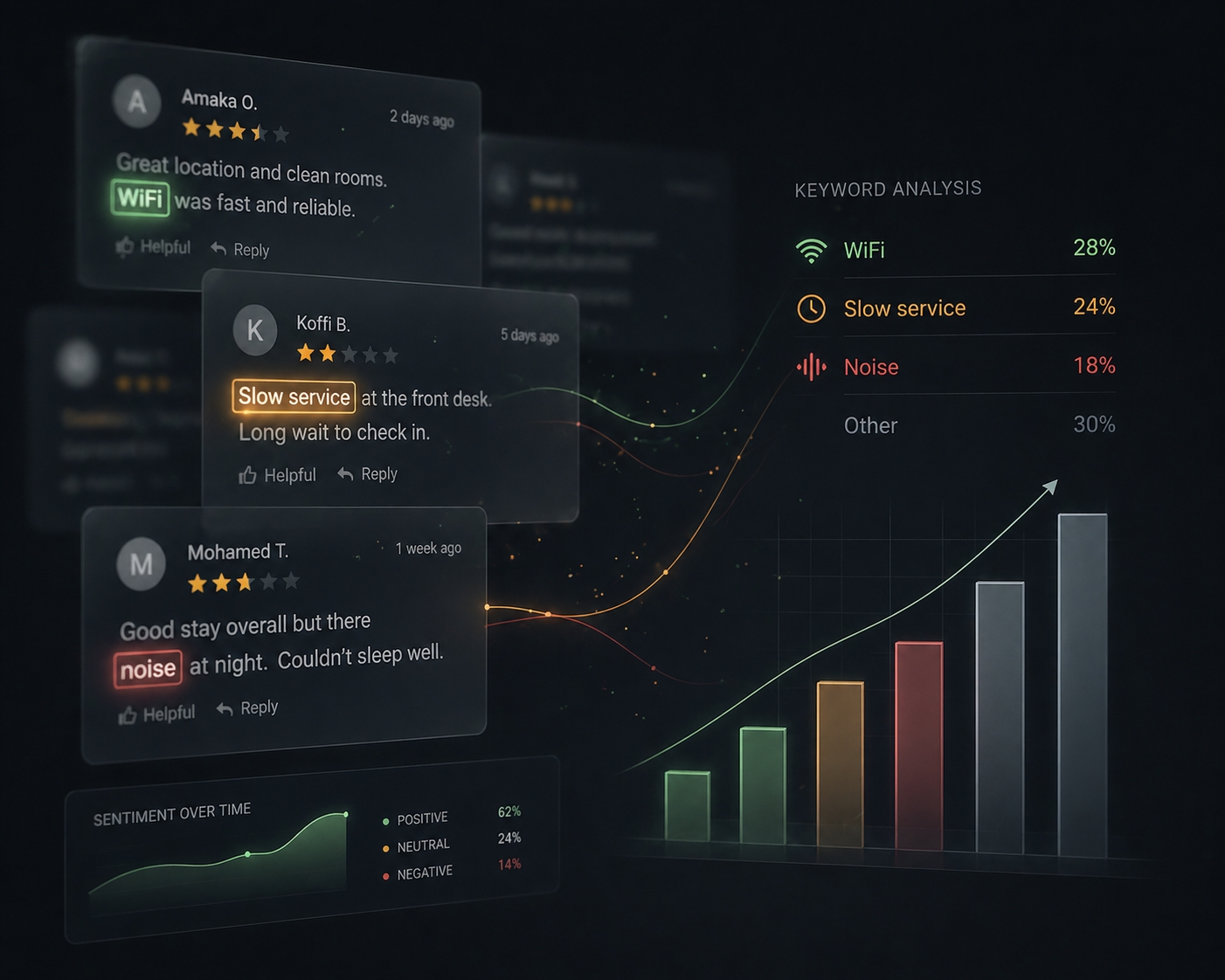
Frequency patterns identify operational failures, not individual bad days.
A single review complaining about slow breakfast service is an outlier — it may have been a genuinely unusual morning. Five reviews over six months that mention slow breakfast service, phrased differently by different guests, are a documented operational pattern. The distinction matters because individual complaints generate defensive responses while patterns generate operational changes.
Go back through your last 40 or 50 reviews and count how often specific issues appear. Not just the one‑star reviews — the three‑star reviews that say “overall good but…” are often the most diagnostically useful because they come from guests who wanted to like the property and were partly disappointed. What are they consistently partly disappointed about?
Common patterns we see in reviews from West African independent hotels:
- WiFi reliability mentioned in more than 20% of reviews almost always reflects a connectivity infrastructure problem, not individual bad luck.
- Comments about “friendly staff but slow service” consistently appearing across multiple reviewers usually indicate a staffing level problem, not a training problem.
- Multiple guests in the same period mentioning noise suggests a room allocation issue that can often be resolved by policy rather than renovation.
Language around value reveals your pricing perception problem before your occupancy data does.
When guests describe a hotel as “good value” or “reasonable for the price,” they are telling you that your delivery slightly exceeds what your price led them to expect. When they describe it as “a bit overpriced” or “not quite worth it,” they are telling you the opposite — and that sentiment is already influencing your future bookings before it shows up in your revenue figures.
Review language about value is a leading indicator. If guests who paid 55,000 CFA consistently describe the experience as slightly overpriced, you have two options: reduce the price to match expectations, or improve delivery to justify the price. What you cannot do is ignore it and expect OTA bookings to remain stable.
Competitor mentions tell you where guests are comparison shopping.
Guests who leave a mixed review sometimes mention where they stayed previously or intend to stay next. “The rooms at X hotel nearby are larger” or “we prefer Y property when we visit but they were full” are pieces of competitive intelligence that your OTA dashboard will never provide.
Track every competitor mention across your last 12 months of reviews. The properties that appear most frequently are your real competitive set — not the ones you assumed you were competing with based on star rating or price tier.
The categories worth tracking explicitly
Rather than reading reviews as narratives, assign each one to the categories most relevant to your property and track frequency over time. A simple spreadsheet with columns for the date, platform, score, and primary subject of the review creates a dataset that is far more useful than the aggregate score.
Useful categories for most West African independent hotels:
- Room quality — cleanliness, maintenance, comfort, noise
- Service speed — check‑in, check‑out, food service, request response
- Staff attitude — helpfulness, professionalism, warmth
- WiFi and connectivity — reliability, speed, coverage across the property
- Breakfast and food — quality, variety, timing, value
- Value for money — explicit mentions of pricing perception
- Location — access, noise from surroundings, safety
- Booking experience — how easy it was to make and modify the reservation
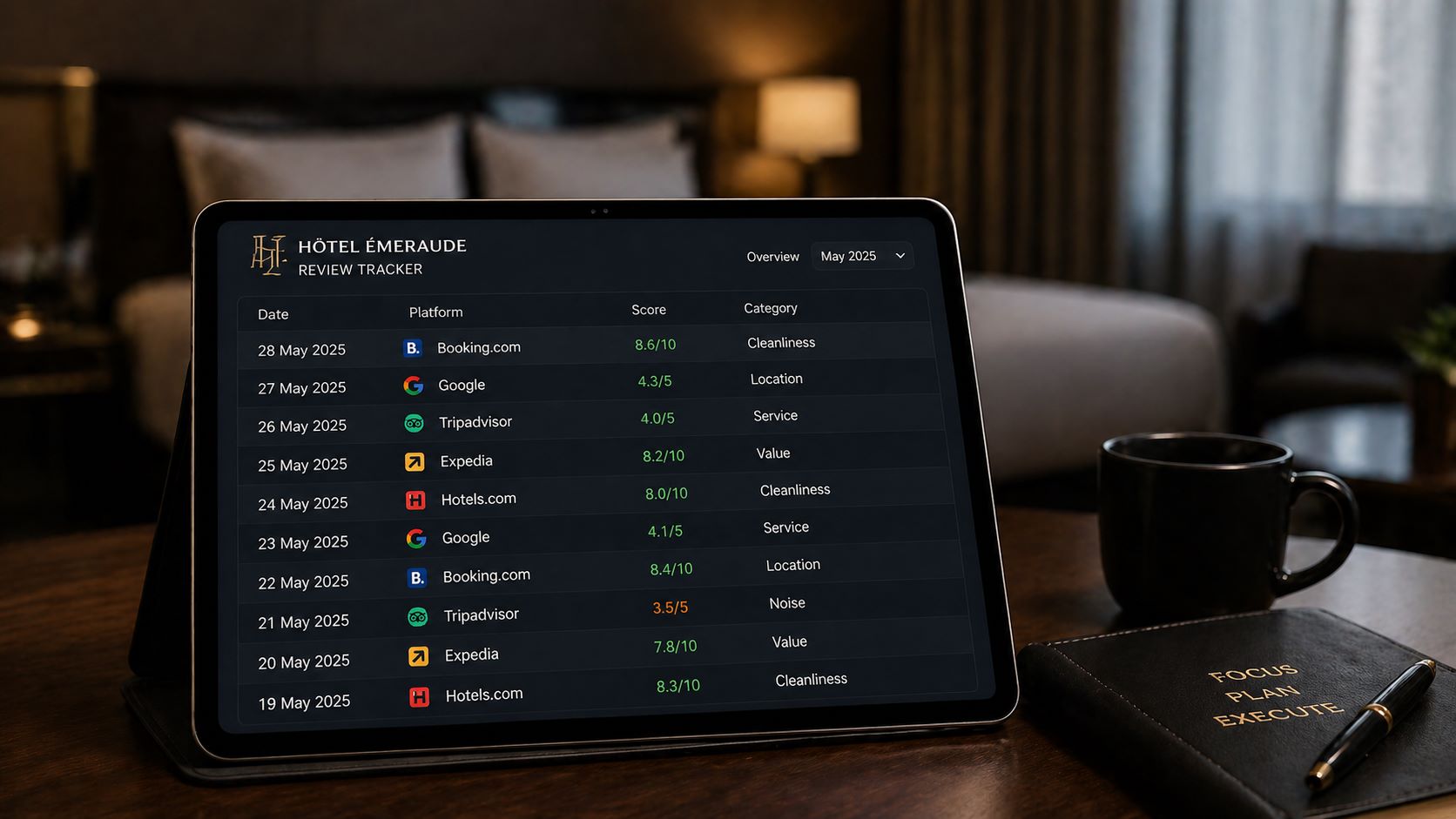
After six months of tracking, patterns become statistically meaningful. After 12 months, you have a baseline against which you can measure whether operational changes have actually shifted guest perception.
Using reviews to understand your best guests
Alongside what is going wrong, reviews reveal who your happiest guests actually are — and this is often more strategically useful.
Read your four‑ and five‑star reviews specifically looking for:
- What type of traveller wrote them — business, leisure, couple, family, solo, regional, international?
- What did they specifically praise that other guests did not mention?
- How did they find the property — OTA, direct, referral, Google?
- How long did they stay?
The guest profile that generates your best reviews is the guest profile you should be marketing to most deliberately. If your highest‑rated reviews consistently come from regional business travellers who booked directly for two to three nights, that tells you exactly where to focus your acquisition effort — regardless of what your OTA traffic data suggests about who is finding you.
A review you should never ignore
The review that most hotel operators dismiss — because it feels unfair or inaccurate — is the one from a guest who had high expectations and felt let down by something that seemed minor.
“The photos looked much better than the actual rooms.” “The website said sea view but the view was partially blocked.” “The breakfast looked great in the photos but the selection was limited.”
These reviews feel unjust because the guest is criticising something that is not exactly your fault. But what they are identifying is a gap between expectation and delivery — which is almost always a marketing and communication problem rather than an operations problem. Your photos, descriptions, and the promises you make online are creating expectations that the in‑person experience is not fully meeting.
This gap, left unaddressed, consistently produces three‑ and three‑and‑a‑half‑star reviews from guests who should have been four‑star guests.
Ginform works with hotel operators to read their review history systematically and identify the operational and communication patterns that most affect their OTA ranking and guest retention.