What Corporate Travel Bookers Actually Look For — And Why Most West African Hotels Miss It
Corporate guests book longer, cancel less, and don’t come through OTAs. Most West African hotels are completely invisible to this segment. Here’s what it takes to get on their radar.
Key takeaways
- Corporate bookers prioritize reliability, correct invoicing, and consistency — not just price.
- If your property isn’t connected to a Global Distribution System (GDS), you’re invisible to most international corporate travel.
- A genuine corporate rate agreement and a named account contact can open long‑term, commission‑free revenue.
- Start by identifying which companies in your city regularly house employees, and reach out directly.
- Corporate accounts are won through trial stays — what you deliver in the first one or two bookings determines whether the relationship grows.
The corporate travel segment has characteristics that should make it the primary target of almost every independent hotel in West Africa. Corporate guests book with less price sensitivity than leisure travellers. They stay for longer periods. They cancel less frequently. They do not generate the one‑night weekend bookings that create high turnover and housekeeping overhead. And they do not come through OTAs — which means no commission, no ranking games, and no dependency on Booking.com’s algorithm.
Most independent hotels in West Africa capture almost none of this segment. The ones that do tend to hold it quietly, because corporate clients, once secured with a well‑managed relationship, are among the most durable revenue sources a hotel can have.
Here is what stands between your property and that segment, and what you need to close the gap.
How corporate travel is actually booked
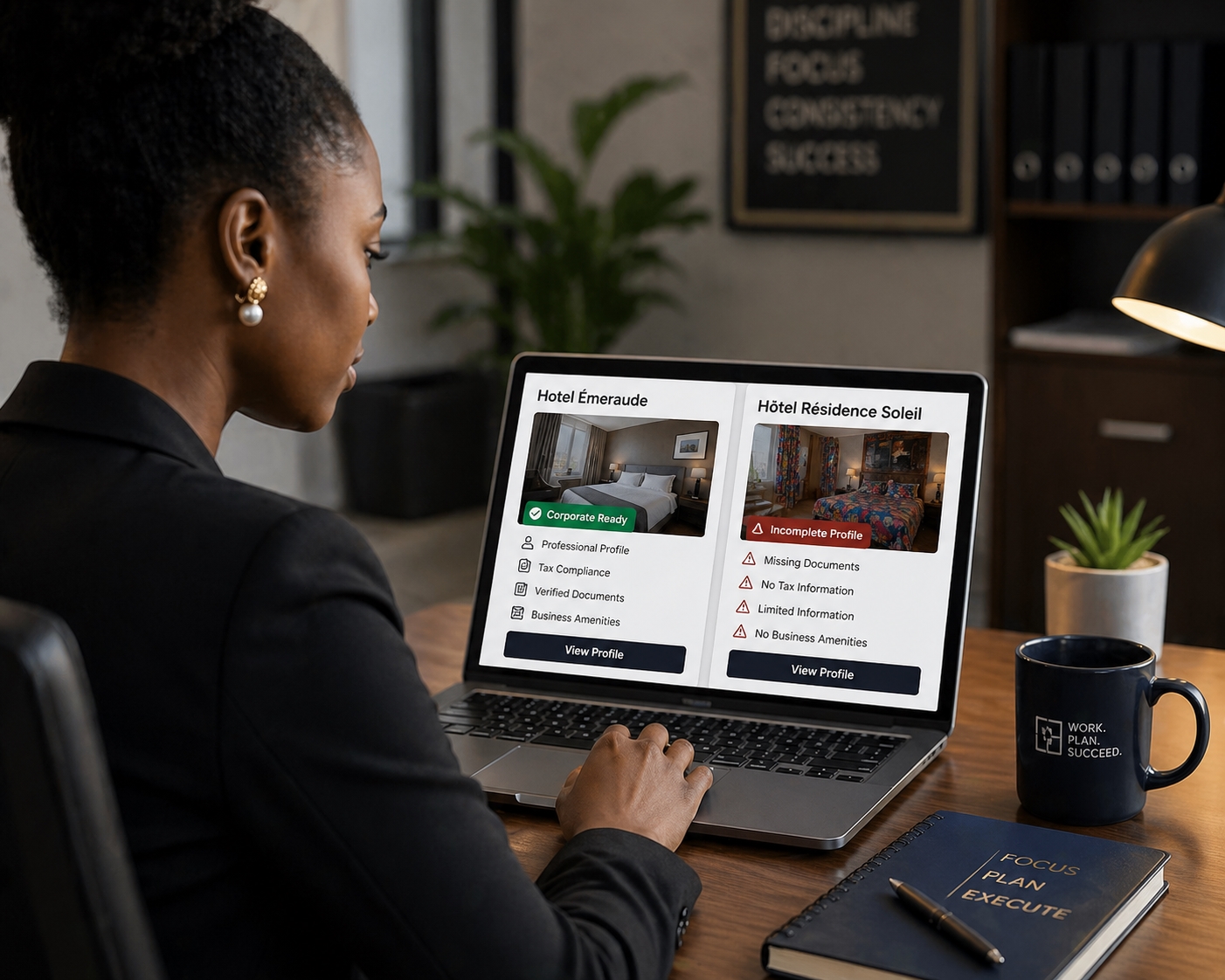
Understanding this segment starts with understanding that the person booking the room is almost never the person staying in it. Corporate accommodation is arranged by travel managers, executive assistants, procurement officers, and increasingly by automated travel management platforms — and the criteria they use have almost nothing in common with the criteria a leisure traveller applies when choosing a hotel on Booking.com.
A corporate booker’s primary concerns are:
Reliability above all else. The traveller is a company asset, often arriving for a critical meeting, project, or client engagement. A room that is not ready, a booking that was not properly communicated, or a breakfast service that fails on a tight morning schedule reflects badly on the person who made the booking. Corporate bookers choose hotels that they know will not create problems. New relationships are built slowly. Reputation and consistency matter far more than price.
Clean, correct invoicing. A corporate guest’s accommodation cost is a business expense that needs to be submitted, approved, and reimbursed against a company account. An invoice with the wrong company name, the wrong dates, or missing VAT information is not a minor inconvenience — it creates administrative work for multiple people and reflects poorly on the property. Hotels that cannot reliably produce accurate, complete invoices on a company letterhead lose corporate clients they would never even know they had lost.
A consistent standard across stays. Corporate clients often send multiple employees to the same city. If the first employee has a good experience and the next has a poor one — a different room type, a different breakfast quality, a different standard of service — the property loses the account. Consistency of delivery, not exceptional occasional delivery, is what retains corporate business.
Rate agreements that function properly. Corporate clients expect a negotiated rate that is honoured automatically when they book, without requiring renegotiation or explanation each time. This requires a basic rate management infrastructure — a way to store and apply a named corporate rate to a specific account. A handshake agreement on a number that gets re‑explained to every new front desk staff member is not a corporate rate agreement.
The GDS problem
Most corporate travel that involves international companies or employees is booked through a Global Distribution System — Sabre, Amadeus, or Galileo. Travel managers at multinational organisations, embassies, and large NGOs typically cannot book accommodation outside of their company’s GDS‑connected travel management platform, regardless of how good the hotel is or how attractive the rate.
If your property is not connected to the GDS, you are invisible to this segment by definition. It is not a matter of marketing better or having a better Booking.com profile. The channel through which these bookings flow simply does not reach you.
GDS connectivity is available through Hotel Link’s channel manager. For hotels positioned near business districts, international airports, or in cities with significant NGO and diplomatic activity — Lomé, Accra, Abidjan, Dakar, Cotonou — GDS connection is not optional if corporate travel is a serious target.
What you need to compete seriously for corporate business
A rate structure that supports corporate accounts. At minimum: a clearly defined corporate rate, a way to apply it consistently to confirmed accounts, and a documented rate agreement that your entire team knows about.
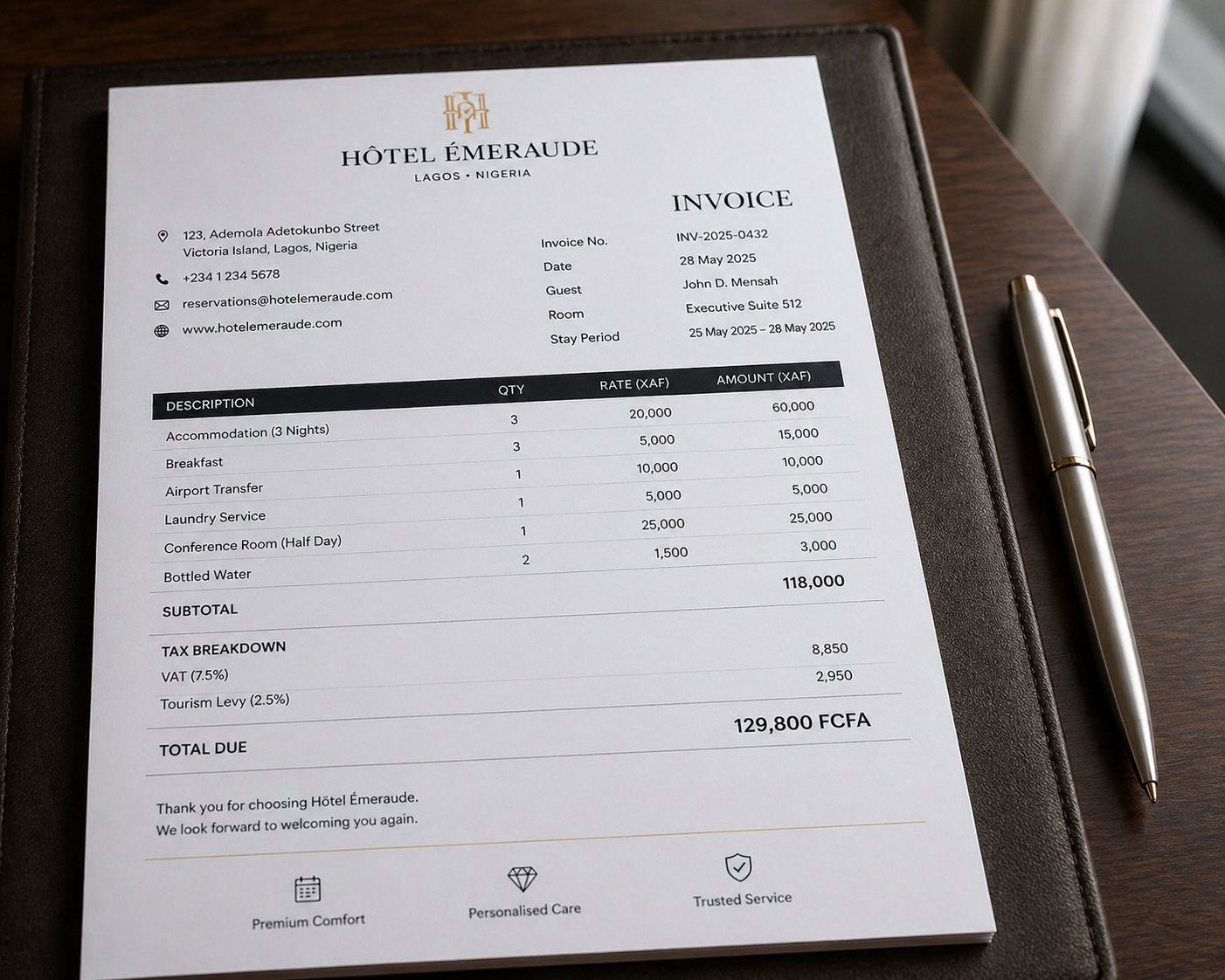
Invoicing that meets corporate standards. Your invoice must show the company name exactly as the client has specified, a clear breakdown of accommodation and any additional charges, applicable taxes identified separately, and your hotel’s full legal name and registration details. This sounds basic. It eliminates a significant number of West African properties from consideration.
A direct contact person for the account. Corporate bookers do not want to call a general number and explain their account from scratch every time. A named contact — a reservations manager or general manager who manages the relationship — is expected and makes a meaningful difference to retention.
Proof of consistency. Corporate accounts are usually won through a trial — one or two stays by a company employee who reports back on the experience. What you do in those first stays determines whether the relationship grows. Standards cannot vary based on occupancy pressure or staff scheduling.
Visibility in the right places. Beyond GDS, corporate clients in West Africa are influenced by peer recommendations, local business directories, and the travel policies of their regional headquarters. A professional, fast‑loading hotel website with a corporate enquiry pathway — not just a general contact form — signals that you are set up for business clients.
Starting the conversation
The first step for most independent hotels is not GDS connectivity — it is identifying which companies in your city regularly house employees in hotels and making direct contact with the person responsible for those bookings.
That list might include: international NGOs with regional offices, embassies and diplomatic missions, multinational companies with local operations, construction and infrastructure contractors, and oil, gas, or mining operations depending on your country.
A brief, professional email introducing your property, your corporate rate, and your invoicing capability — followed by an invitation to tour the property — is how most independent hotel corporate relationships begin. It is not complicated. It simply requires treating corporate acquisition as a deliberate activity rather than something that happens when a business traveller finds you on Booking.com.
Ginform can help you identify your corporate opportunity, configure your rate structure, and establish GDS connectivity through Hotel Link.
Contact us to discuss your property’s corporate travel strategy