The Future of Hospitality Technology in West Africa

West Africa leapfrogged traditional banking with mobile money. The same shift is happening in hotel technology. Here's what's coming — and how forward-thinking hotels are preparing.
The Future of Hospitality Technology in West Africa
If you look at how West Africa leapfrogged traditional banking infrastructure with mobile money — T-Money, Flooz, MTN MoMo, Orange Money — you start to see a pattern. The region does not always follow the old playbook. Sometimes it writes a new one.
The same shift is now underway in hotel technology. Hotels that move early will capture more direct bookings, earn stronger guest loyalty, and spend less on commissions. Those that wait will find themselves competing at a disadvantage against properties that have already made the transition.
Here is what the landscape looks like today, where it is heading, and what Ginform is already doing to bring it to West Africa.
Where most hotels stand today
The majority of hotels across the region still rely on:
- Walk-ins and phone calls, with no digital record of the transaction.
- A single OTA — usually Booking.com — for the bulk of their bookings.
- Manual spreadsheets or paper registers to track reservations.
- No hotel website, or one that is slow, not mobile-optimised, and has no booking engine.
At the same time, the travellers checking into these hotels — both local and international — expect to search online, book from a phone, pay with mobile money, and receive instant confirmation. The gap between what guests expect and what most hotels currently offer is significant. That gap is where the opportunity lives.
Three trends shaping the next five years
1. The shift from OTA-first to direct-first
The 15 to 25% commissions charged by major OTAs are not sustainable as a primary revenue model. Forward-thinking hotels are building direct booking engines on their own websites and actively encouraging guests to use them — through best rate guarantees, loyalty perks, and smart email campaigns.
The winning approach is not abandoning OTAs. It is using a channel manager to stay visible across all platforms while steadily shifting the share of bookings that flow through your own channel. Hotels that do this consistently reduce costs every quarter while their OTA rankings remain stable or improve.
2. Mobile-first becomes the baseline, not the upgrade
The guest journey no longer begins at your front desk. It begins on a smartphone, often weeks before arrival. Hotels that deliver a seamless mobile experience at every stage — search, booking, check-in, in-stay service, checkout — will earn stronger reviews and higher repeat rates.
In the near term, this means having a mobile-optimised website with a fast, embedded booking engine. In the medium term, it means digital check-in, in-app service requests, and contactless checkout. Hotel Link's mobile-optimised ecosystem is already moving in this direction, and Ginform is implementing these tools for West African properties today.
3. Data-driven pricing replaces intuition
Many hotels still set room rates based on instinct, competitor observation, or seasonal habit. Dynamic pricing — adjusting rates automatically based on current occupancy, local demand signals, and market conditions — is becoming standard practice globally and is increasingly accessible for independent properties.
Hotels using data to drive pricing decisions consistently outperform those that do not on revenue per available room (RevPAR). This is no longer a tool reserved for large branded chains. Hotel Link's Smart Rate feature brings this capability to independent hotels across the region.
The challenges specific to West Africa — and how we address them
Every market has its constraints. West Africa's are real, and they require solutions built for local conditions — not adapted from tools designed for Europe or North America.
Unreliable internet connectivity — Hotel Link's booking engine is lightweight and designed to function effectively on slower connections. We also support local hosting options where bandwidth is a consistent challenge.
Mobile money as the primary payment method — International payment gateways often fail or go unused in West African markets. Our integrations include T-Money, Flooz, MTN MoMo, and Orange Money alongside card payments, so your guests can pay the way they actually do.
Bilingual operations — Ginform provides full English and French support across our tools and across our team. For hotels operating in Francophone markets, this is not an afterthought — it is the standard.
Local support that actually responds — We are based in Lomé. When you need support, you reach a team that understands your context, speaks your language, and can be reached by phone or WhatsApp.
What is coming in the next three to five years
These developments are not speculative. They are already being deployed in markets ahead of ours, and they will reach West Africa on a shorter timeline than most expect.
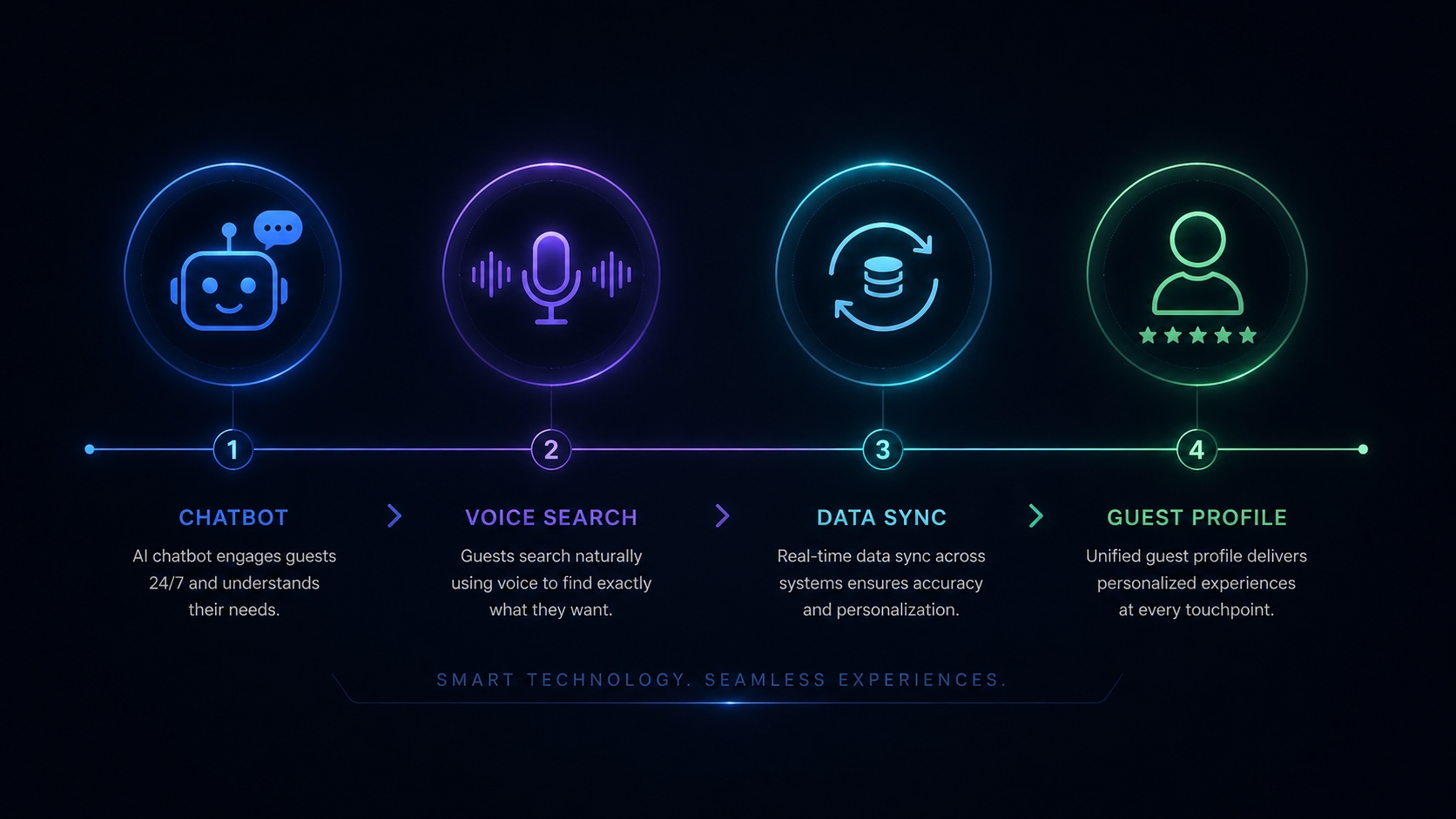
AI-powered guest communication — Chatbots that respond to enquiries and booking questions in real time, in French and English, around the clock, without requiring a staff member.
Voice search integration — Guests searching "hotel near Lomé airport" or "boutique hotel in Accra" through Google and voice assistants will increasingly surface properties with structured data and optimised digital presence.
Fully connected operations — Your property management system, booking engine, channel manager, and front desk will function as a single integrated system, eliminating manual data entry and reducing errors.
Guest profile intelligence — Returning guests recognised automatically. Room preferences, dietary requirements, previous feedback — available to your team before the guest walks through the door.
Ginform is already working with Hotel Link to bring these capabilities to West Africa. We are not waiting for global brands to adapt their tools to our context. We are building the infrastructure now.
The window is open — but not indefinitely
Every technology shift has an adoption curve. The hotels that act now will build a lead that is genuinely difficult for later movers to close — in direct booking share, in guest data, and in the operational efficiency that compounds over time.
The future of hospitality technology in West Africa is not a prediction. It is already underway.